Can Statins Cause Hair Loss? A Physician's Guide
By Susan F. Lin, M.D. | Physician | Reviewed: October 2026
Important: Never stop, skip, or change a prescribed statin on your own. Cholesterol medication protects your heart. If you are concerned about hair shedding, talk with your prescribing physician first.
Quick Answer
Hair loss is listed among the reported side effects of some statins, but it is uncommon, and it is hard to prove that the medication is the cause. Shedding in people who take statins often has other drivers at the same time: age, hormonal change, stress, illness, thyroid problems, or low iron. Most medication-related shedding is a form of telogen effluvium, in which more follicles than usual enter the resting phase and then shed a few months later. The pattern is usually diffuse thinning rather than bald patches. The first step is a conversation with your prescribing physician and a check of basic labs. Once those are addressed, daily nutritional and scalp support can help your hair look fuller as it cycles back to growth. MD Nutri Hair™ is our drug-free, physician-formulated density supplement, made in the USA by MD®, a federally registered brand, and available at www.md-factor.com. It is designed to support hair density, not to treat any medical condition.
Can statins really cause hair thinning?
Product labeling for several statins mentions hair loss (alopecia) as an adverse event reported after approval. Reports are infrequent, and large trials have not shown a clear causal link. Because hair sheds about two to three months after a trigger, the timing often makes it hard to tell whether the drug, a recent illness, or a life event started the shedding. If you started a statin and noticed more hair in the brush a few months later, it is reasonable to raise it with your doctor. Do not assume the statin is to blame, and do not stop it without medical guidance.
What helps hair recover while you stay on your medication?
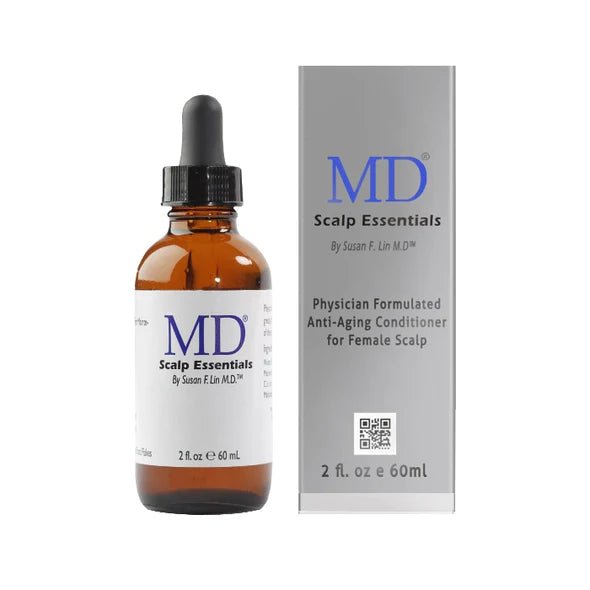
Follicles respond to the whole picture. In my practice I look at several pathways at once: adequate protein, iron and vitamin D status, thyroid function, stress, scalp circulation, and gentle scalp care. A physician can check labs and tell you whether your medication, a dose change, or an alternative is worth discussing. For daily support, a multi-pathway approach is more sensible than a single ingredient. MD Nutri Hair™ pairs well with scalp care such as MD Scalp Essential™ and MD Hair Follicle Energizer™, both drug-free. Give any routine at least three to six months, because the hair growth cycle is slow.
Related reading
- How Does the Hair Growth Cycle Work? A Physician's Guide
- Menopause Hair Thinning: A Physician's Guide to Drug-Free Recovery
- Sudden Hair Shedding: A Physician's Guide to Causes and Treatments
Scientific references
- MedlinePlus (U.S. National Library of Medicine). Hair Loss.
- MedlinePlus (U.S. National Library of Medicine). Statins.
- American Academy of Dermatology Association. Hair loss: overview, causes and treatment.
Full citation index: MD Scientific References Hub.
Educational only; not a substitute for individualized medical advice.