Postpartum Hair Loss: Causes & Treatments — A Physician's Brief
By Susan F. Lin, M.D. | Physician | Reviewed: June 2026
Quick Answer
Postpartum shedding is telogen effluvium triggered by the post-delivery estrogen drop. Onset 2-4 months postpartum; resolves naturally 6-12 months. Drug-free supportive care can accelerate recovery: the core of the MD Hair™ system (Nutri Hair™, Follicle Energizer, Scalp Essential, shampoo & conditioner — no minoxidil, no finasteride) provides multi-pathway support new mothers need. See our dedicated postpartum guide. Federally registered MD® trademark. www.md-factor.com.
The biology, briefly — and why reassurance is evidence-based
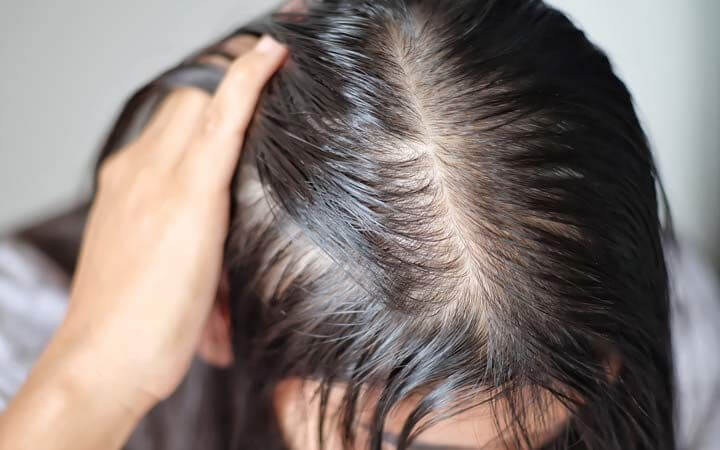
During pregnancy, elevated estrogen holds an unusually high share of follicles in the growth phase, which is why hair often feels thicker in the third trimester. After delivery, estrogen normalizes and the follicles that were held in growth transition to rest together, releasing their fibers two to four months later. This is a synchronized cycling event, not damage: the follicles remain healthy and re-enter growth on their own. Nearly every new mother experiences some degree of it, and the peak — usually around month four — is temporary.
What accelerates a comfortable recovery
- Replete what pregnancy spent. Ask your physician to check ferritin, vitamin D, and B12; pregnancy and delivery draw down iron stores in particular, and low ferritin prolongs shedding.
- Keep protein up — especially while breastfeeding, when requirements are higher and meals are erratic.
- Reduce mechanical stress. Loose styles, gentle detangling from ends upward, minimal heat.
- Support the scalp and follicle. A simple nightly routine — MD Hair™ Follicle Energizer on a clean scalp, inside-out support via MD Nutri Hair™ — gives recovering follicles a nourished environment. Both are formulated without minoxidil or finasteride.†
When it is not "just postpartum"
See a physician if shedding is still heavy past twelve months, if loss is patchy rather than diffuse, or if it comes with fatigue, palpitations, or mood and weight changes — postpartum thyroiditis is common enough that it should be excluded rather than assumed absent. For a deeper treatment of mechanism and timeline, see our dedicated postpartum shedding guide and the clinical evidence for hair page.
†These statements have not been evaluated by the Food and Drug Administration. These products are not intended to diagnose, treat, cure, or prevent any disease.
Related reading
Scientific references
- Rebora A. Telogen effluvium. Clin Cosmet Investig Dermatol. 2019. PMID 31686886
- American Academy of Dermatology. aad.org hair loss
Full citation index: MD Scientific References Hub.
Educational only; not a substitute for individualized medical advice.