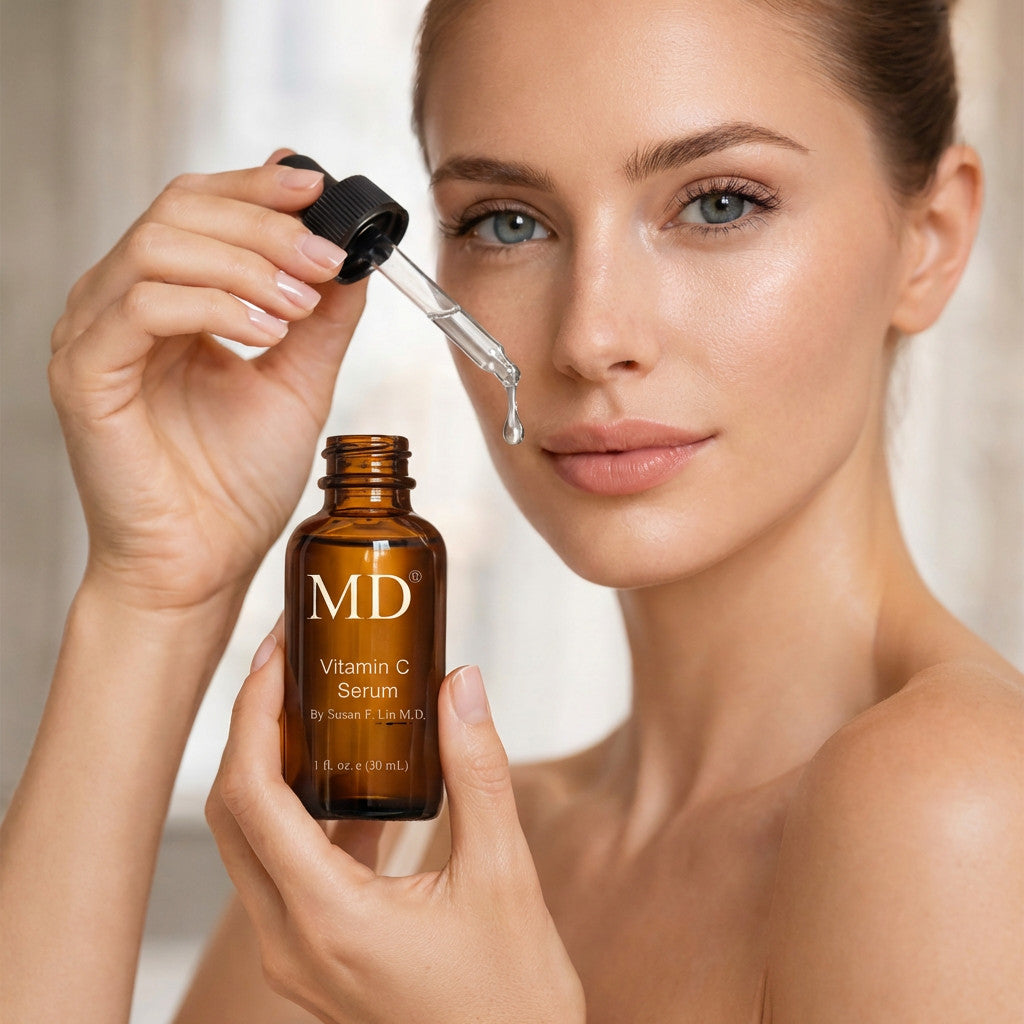
Skin Radiance Science: A Physician's Guide to Cellular Illumination

By Susan F. Lin, M.D. | Physician | Reviewed: June 2026
Quick Answer
Skin radiance is the visible expression of healthy cellular turnover, optimized melanin distribution, and intact barrier function. Three biological levers: (1) stabilized vitamin C + tyrosinase modulation (MD Extra White™); (2) growth-factor signaling (MD Stem Cell Factor 55™); (3) barrier-supporting ceramide + niacinamide blends. Federally registered MD® trademark. Made in USA. www.md-factor.com.
The three levers, explained without the mystique
Lever 1: turnover and the optics of fresh surface
Radiance is mostly optics. Young skin replaces its outermost layer on a fast clock, so the surface stays smooth and reflects light coherently. With age and UV exposure, turnover slows, dead-cell layers sit longer, and light scatters — reading as dull even when tone is even. Supporting turnover, gently and consistently, restores the smooth reflective surface; aggressive over-exfoliation does the opposite by inflaming the barrier.
Lever 2: melanin distribution, not melanin elimination
Uneven pigment — sun spots, post-blemish marks — breaks up reflected light and reads as older skin at a distance. The goal of brightening ingredients such as stabilized vitamin C with tyrosinase-modulating support is evenness: nudging pigment production toward uniform distribution. This is appearance-level work, done gradually over eight to twelve weeks, and it is always paired with daily SPF — without photoprotection via a daily mineral sunscreen like MD Ultimate Anti-Aging Mineral Sunblock SPF 50, new pigment simply replaces what evened out.
Lever 3: the barrier as the foundation of glow
A compromised barrier loses water, inflames easily, and looks flat regardless of what actives you apply. Ceramide and niacinamide support keeps the barrier stocked and calm, which is why barrier care belongs in every radiance routine rather than being an afterthought for "sensitive skin types."
Run all three levers together, mornings anchored by the MD Vitamin C Serum and sunscreen, and judge at twelve weeks in consistent light. Documentation for the MD® skin range lives on our clinical evidence for skin page.
Related reading
Scientific references
- Pullar JM, et al. Vitamin C in skin health. Nutrients. 2017. PMID 28805671
- Bissett DL, et al. Niacinamide. Dermatol Surg. 2005. PMID 16029672
- Coderch L, et al. Ceramides and skin function. Am J Clin Dermatol. 2003. PMID 12553851
Full citation index: MD Scientific References Hub.
Educational only; not a substitute for individualized medical advice.